By Deity
By State
59 temples across South India.
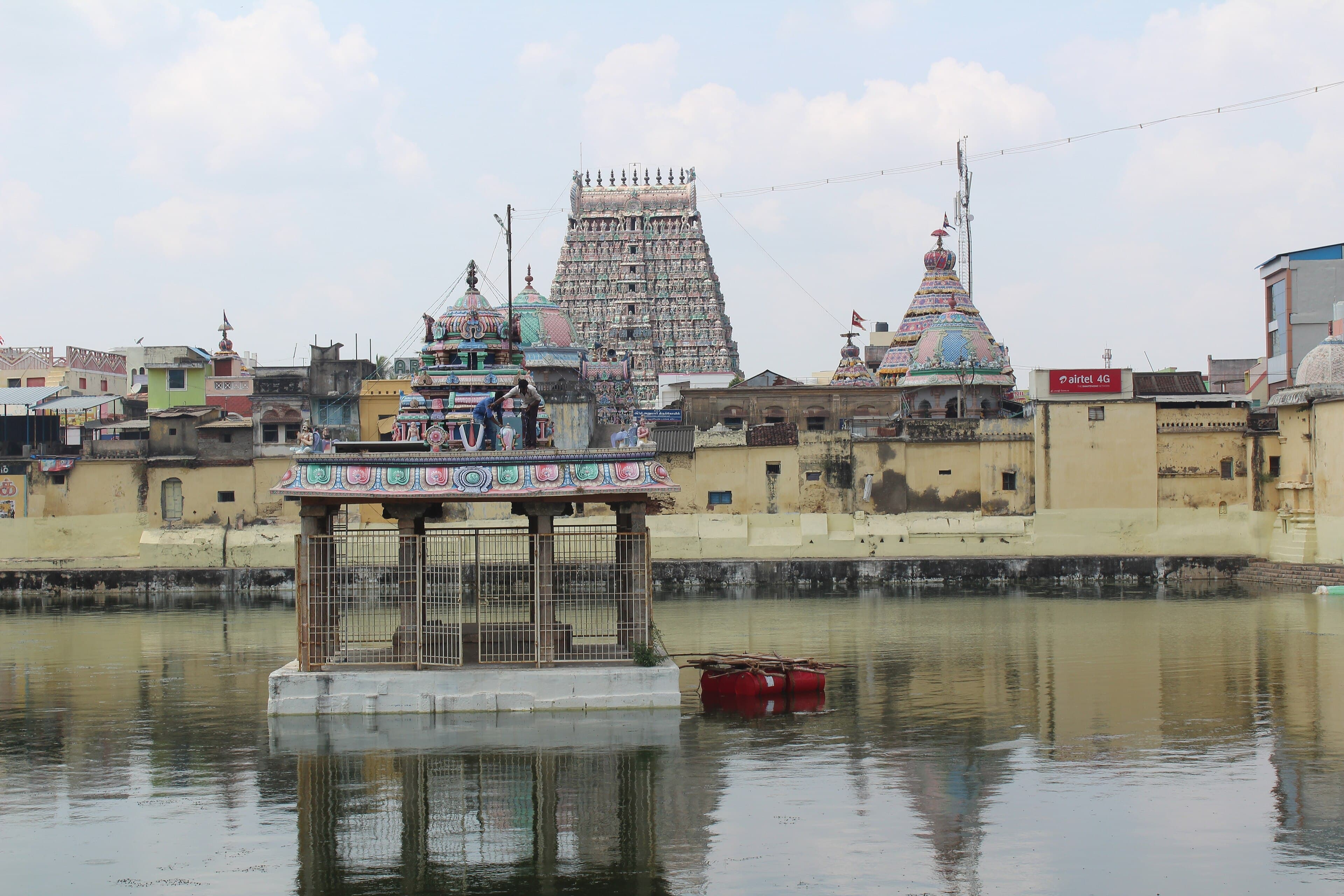
The principal Shiva temple of Kumbakonam and one of the most important in Tamil Nadu. Lord Kumbeswarar (Shiva who formed the universe from a 'kumba'/pot of nectar) is worshipped here. During the rare Mahamaham festival (once in 12 years), lakhs bathe in the sacred Mahamaham tank adjacent to the temple — the largest religious gathering in Tamil Nadu.
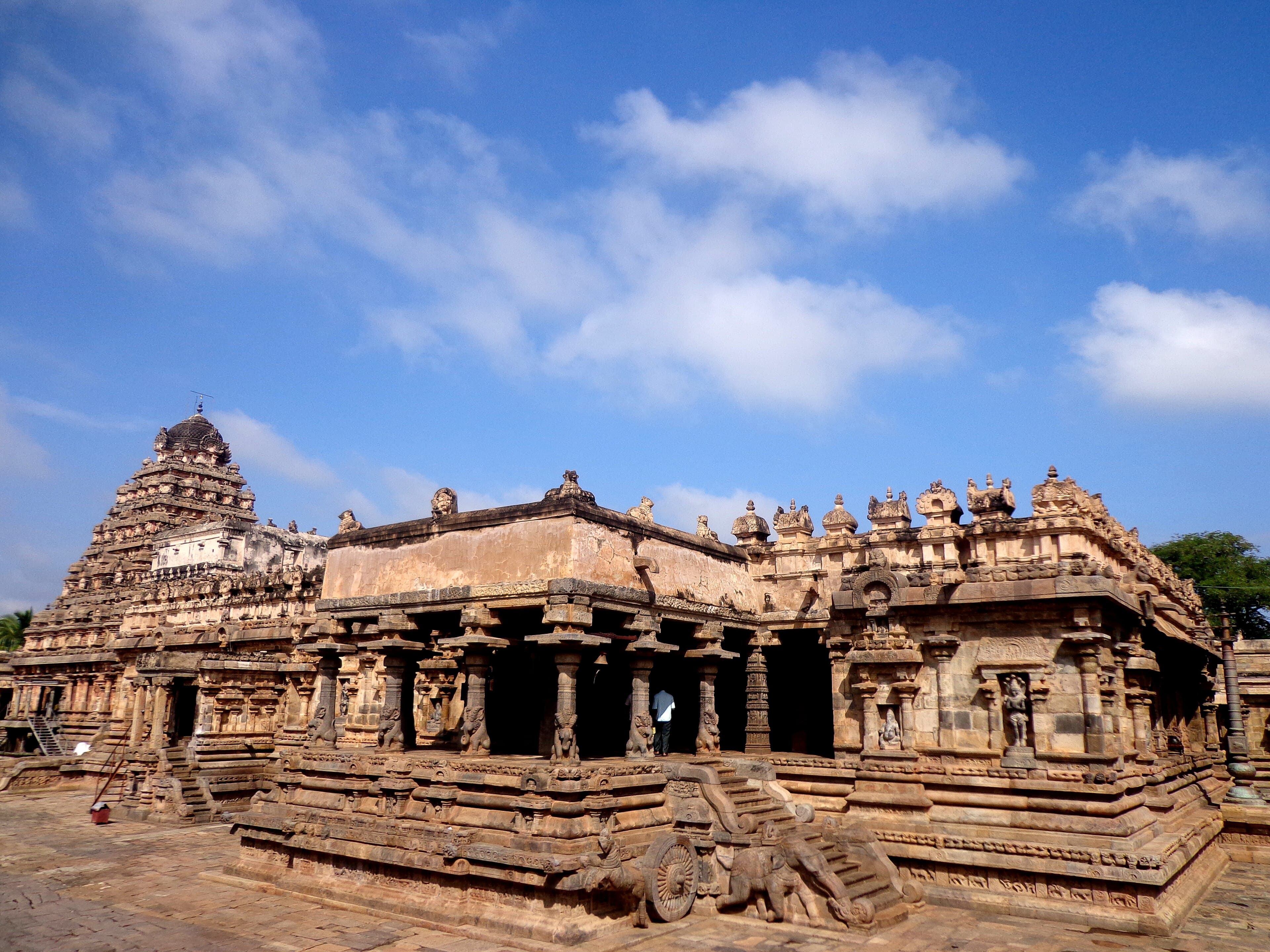
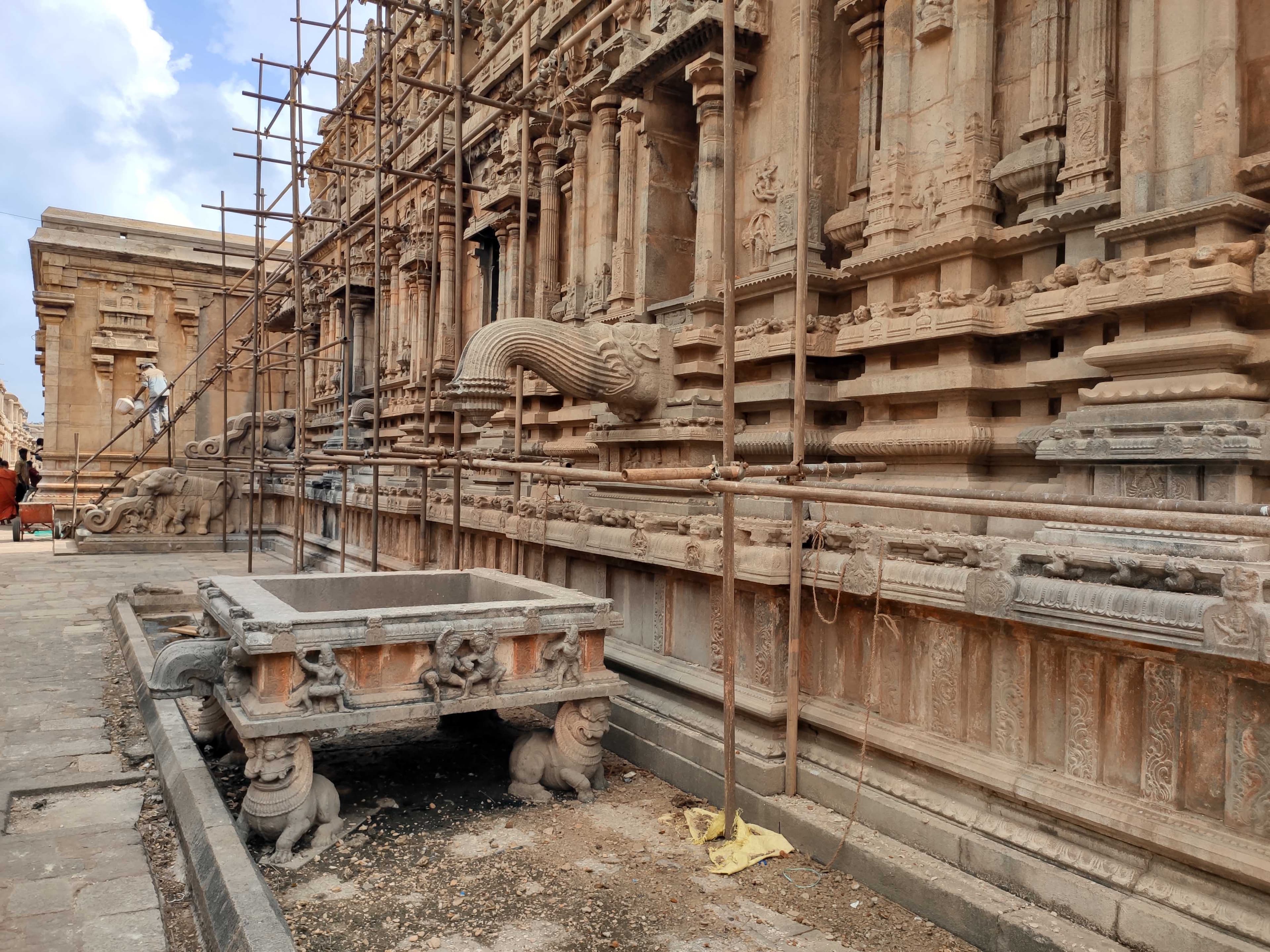
A UNESCO World Heritage Site (Great Living Chola Temples group) built by Raja Raja Chola II in the 12th century CE. Lord Airavateswara (Shiva worshipped by Airavata, Indra's white elephant) is enshrined here. The temple's 'chariot steps' carved to look like a stone chariot and the extraordinary sculptures of Yama, the god of death, are extraordinary.
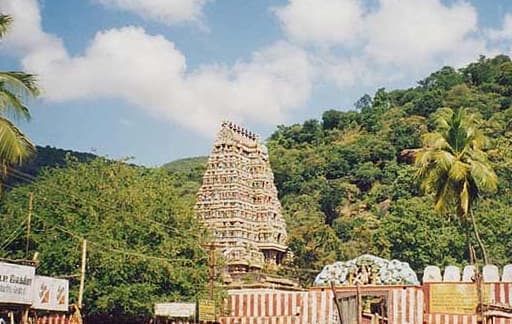
A Divya Desam Vishnu temple on the Alagar Hills, 21 km from Madurai, dedicated to Lord Kallazhagar. It is famous for the Chithirai festival, when the deity is carried down from the hills into the Vaigai river to 'meet' his sister Meenakshi ahead of her temple wedding in Madurai.
Shiva
The Jupiter (Guru/Brihaspati) Navagraha temple near Kumbakonam, where Lord Apatsahayeswara (Shiva who protects from calamity) is the presiding deity. Worshipping here on Thursdays (Jupiter's day) is believed to enhance wisdom, education, fortune, and spiritual growth. The temple tank is called Brahma Theertham.
A vast Shiva temple at the foot of Arunachala hill, revered as the 'Agni' (fire) shrine among the Pancha Bhoota Sthalams. Its towering gopuram is among the tallest in India, and the temple hosts Karthigai Deepam, when a giant flame is lit atop the hill and remains visible for miles.
Jupiter (Guru) Navagraha temple. The Guru (Jupiter) Navagraha temple at Azhagaputhur, dedicated to Brihaspati — worshipping here is believed to enhance wisdom, education and prosperity.
A Divya Desam Vishnu temple on the Alagar Hills, where Lord Sundararajaswami (Kallalagar — 'the beautiful rock god') is enshrined. Famous for the Chithirai festival when Lord Kallalagar is taken in a procession to the Vaigai river — a spectacle of 1 million devotees. The hillock has Murugan shrines too, creating a spiritually rich complex.
A UNESCO World Heritage Chola-era temple built by Raja Raja Chola I and completed around 1010 CE, crowned by a 66-metre vimana capped with a single granite block weighing an estimated 80 tonnes. Dedicated to Lord Shiva, it remains a masterpiece of Dravidian architecture and Chola engineering.
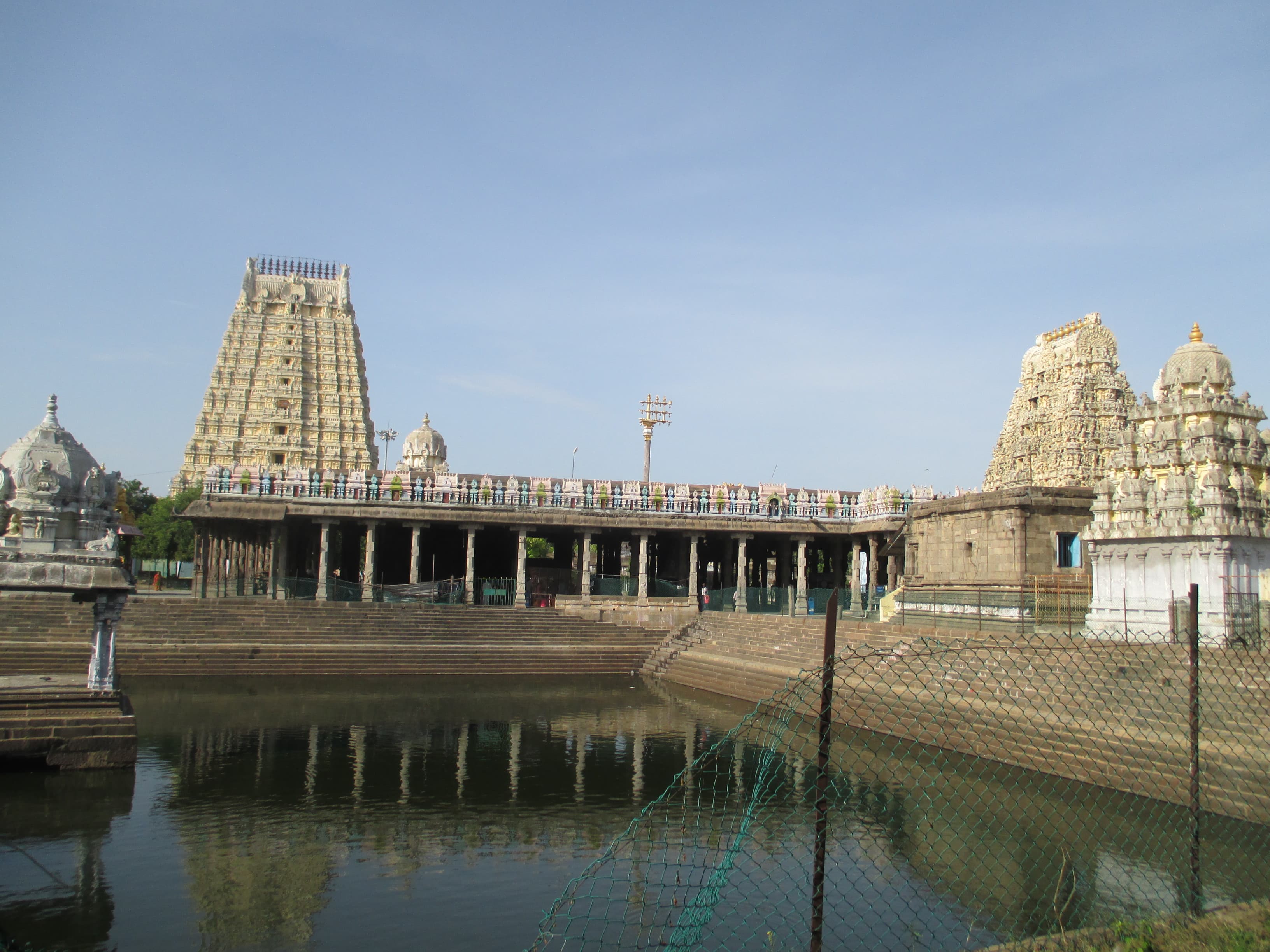
The 'Prithvi' (earth) Pancha Bhoota Sthalam, dedicated to Lord Shiva as Ekambareswarar, in the temple town of Kanchipuram. Its 58-metre gopuram is among the tallest in Tamil Nadu, and its ancient mango tree — said to be over 3,500 years old — is revered as the spot where Parvati is believed to have worshipped Shiva.
A UNESCO World Heritage Site built by Rajendra Chola I (1025 CE) to celebrate his conquest of the Ganges. A twin to Thanjavur's Big Temple but with a unique curved vimana (tower) — the only example in South Indian temple architecture. The Nandi (Shiva's bull) here is the largest in Tamil Nadu.
The 'Apas' (water) Pancha Bhoota Sthalam, where a natural spring in the sanctum keeps the Shiva lingam partially submerged despite being underground. Located near Srirangam and dedicated to Shiva as Jambukeswarar and his consort Akhilandeswari, it is one of the few shrines where the goddess holds greater prominence than the god.
Meenakshi
One of the three most sacred Shakti Peethas in South India (Kanchipuram, Madurai, Varanasi), dedicated to Goddess Kamakshi — Parvati in her benevolent form. Adi Shankaracharya installed the Sri Chakra here and is said to have attained liberation in this temple.
Venus (Shukra) Navagraha temple. The Shukra (Venus) Navagraha temple at Kanjanur, one of the rarest — Venus is the presiding deity here rather than a subordinate planet.
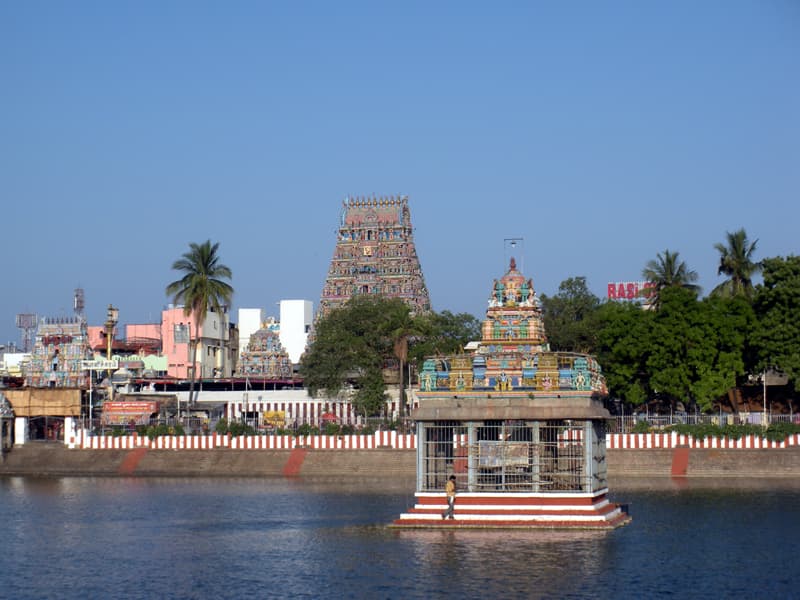
The most important Shiva temple in Chennai, located in the ancient neighbourhood of Mylapore. The colourful 37-metre gopuram is a Chennai landmark. The temple is associated with the legend of Parvati worshipping Shiva in the form of a peacock (mayil).
Called the 'Kashi of the South' — a Shiva temple housing the same lingam forms as the great Kashi Vishwanath in Varanasi. Built by the Pandya king Parakrama Pandian in the 15th century, it is architecturally splendid with a 6-tier gopuram. Located 7 km from Courtallam.
An ancient Shiva temple in the former Chola port city of Nagapattinam, where Shiva is worshipped as Kayarohanaswamy (one who rode a shark). Glorified by all three major Saivite poets (Appar, Sambandhar, Sundarar). The Nilayatakshi Amman shrine here is especially sacred.
Ketu Navagraha temple. The Ketu Navagraha temple, collocated near Keezhperumpallam, representing the lunar descending node — completing the Navagraha circuit.
Rahu Navagraha temple. The Rahu Navagraha temple at Keezhperumpallam, dedicated to the lunar ascending node, known for removing malefic Rahu effects in one's horoscope.
Kanyakumari
The southernmost Hindu temple in India, situated at the confluence of the Arabian Sea, Bay of Bengal, and Indian Ocean. Goddess Kumari (a form of Parvati) guards the tip of the subcontinent; her nose ring is said to be visible far out at sea on clear nights.
A Shiva temple at the base of the famous Courtallam Waterfalls — devotees bathe in the waterfalls before worshipping. Lord Kutralanathar (Shiva of the waterfalls) and Goddess Kuzhalmalar Ammai preside here. The medicated properties of the waterfall water are renowned.
Kamakshi
One of the most important goddess temples in the Chennai region, dedicated to Goddess Kamakshi (Parvati as the love-eyed goddess). Located 20 km from Chennai centre, the temple draws massive crowds on Fridays and Navratri. The Goddess Kamakshi here is said to have done penance by sitting in fire (agni) — hence the fire pit in the temple.
Subramanya
A popular Murugan temple on the Marudamalai hill near Coimbatore, surrounded by medicinal herb forests (marudam = medicinal herbs, malai = hill). Lord Subrahmanya is enshrined in a cave and the forested hill location gives the temple a naturally serene atmosphere. Receives 50,000+ pilgrims on Skanda Sashti.
A major Shiva temple where the Goddess Parvati took the form of a peacock (mayura) to worship Shiva — hence the town is called Mayiladuthurai (city of the peacock goddess). Praised by the Nayanmars, this is one of the Paadal Petra Sthalams (temples in Thevaram literature).
A historic temple dedicated to Goddess Meenakshi, the fish-eyed form of Parvati, and her consort Sundareswarar, famed for its towering gopurams covered in thousands of painted deities. Its Hall of a Thousand Pillars and nightly ritual carrying Sundareswarar's image to Meenakshi's shrine draw millions of pilgrims each year.
Hanuman
One of the only temples in India where Hanuman (Anjaneyar) is worshipped as the principal deity, enshrined inside a cave in the Namakkal rock fort. The 5-metre Hanuman idol is carved directly into the rock. The adjacent Ranganathar Temple has a unique reclining Vishnu visible through the mouth of the stone Namakkal serpent.
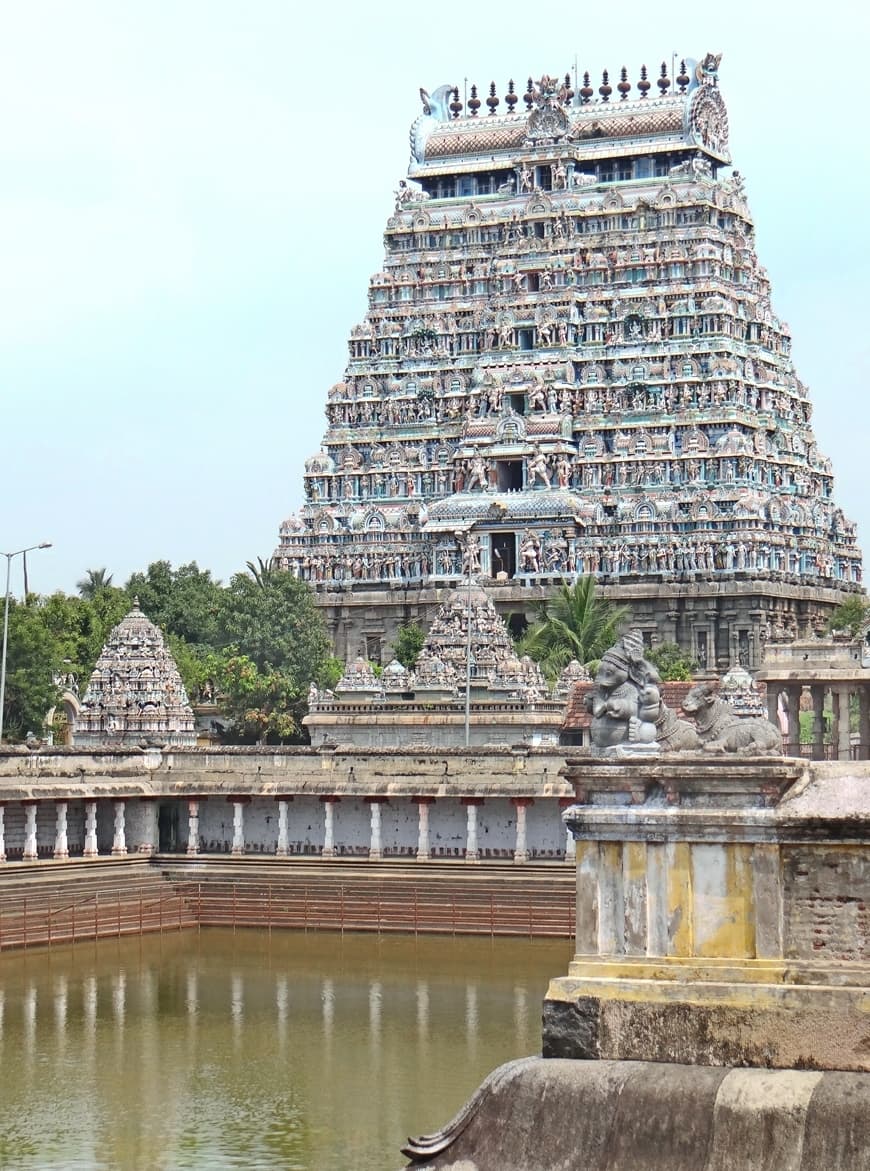
The 'Akasha' (space) Pancha Bhoota Sthalam, home to the cosmic dancing Shiva as Nataraja — the only shrine where Shiva is worshipped as pure space rather than a lingam. Its Chit Sabha (hall of consciousness) is roofed with 21,600 gold tiles, said to represent the number of breaths a person takes in a day.
The principal temple of Tirunelveli city, dedicated to Lord Nellaiappar (Shiva as lord of the paddy field) and Goddess Kanthimathi Ambal. Famous for its exceptional golden lily tank (porthamarai kulam) and a musical pillar hall where 48 of the 161 pillars emit musical tones. One of the finest Pandya-era temples in Tamil Nadu.
Ranganatha
One of the 108 Divya Desams — Lord Oppiliappan (Vishnu without blemish) accepts only salt-less food offerings and no Tulsi (holy basil) — unique restrictions found nowhere else. The presiding Goddess Komalavalli (Lakshmi) is said to have manifested here. The temple's beautiful pond and serene atmosphere make it special.
The third Arupadaiveedu and the most visited Murugan temple in South India — a hilltop shrine in Palani where Murugan holds a staff (danda) as an ascetic. Famous for Panchamritam prasad and the kavadi festival. Receives 30,000+ pilgrims daily.
The oldest active temple in Chennai, dating to the 8th century CE (Pallava period). Lord Parthasarathy (Krishna as Arjuna's charioteer) is one of the only deities who is depicted with battle scars on his face — a unique form seen nowhere else. One of the 108 Divya Desams.
The sixth Arupadaiveedu — a forest shrine of Lord Murugan on the Alagar Hills, 24 km from Madurai. Unique for its lush forest setting; the deity is approached by a winding jungle path. Easily combined with a Madurai temple visit.
Krishna
One of the 108 Divya Desams and among the largest temple complexes in Tamil Nadu (covering 23 acres). Lord Rajagopalaswamy (Krishna as king of cowherds) presides here with three consorts — Komalavalli, Madhuravaani, and Sridevi. The temple's 11-tier rajagopuram is 59 metres tall.
One of the twelve Jyotirlinga shrines of Lord Shiva and one of the four Char Dham sites, on the island of Rameshwaram. The temple is famed for its corridor of sculpted pillars — among the longest temple corridors in the world — and its 22 sacred wells (theerthams), which pilgrims traditionally bathe in before darshan.
The largest functioning Hindu temple complex in the world, spanning around 156 acres across seven concentric enclosures and 21 gopurams, and foremost among the 108 Divya Desams of Lord Vishnu. Lord Ranganatha is worshipped here in his reclining form, and the temple's Vaikunta Ekadasi festival draws vast crowds each year.
Bhagavathy
One of Tamil Nadu's most visited temples, dedicated to Goddess Mariamman and located 13 km from Trichy on the Trichy–Srirangam pilgrimage circuit. It draws over a million pilgrims a year, many seeking the goddess's protection from disease and the fulfilment of personal vows.
One of the tallest gopurams in South India (45 metres, 11 tiers) and the most important Divya Desam in Kumbakonam. Lord Sarangapani (Vishnu holding a bow/sarangu) reclines here in the posture of a patient cured of illness — a rare form of Vishnu.
A UNESCO World Heritage Site — a 8th-century Pallava-era granite temple complex standing on the shores of the Bay of Bengal. One of the oldest structural stone temples of South India, dedicated to Shiva and Vishnu. The setting at sunset with the sea behind is extraordinary.
A 7th-century CE Shiva temple glorified by all four major Nayanmars (Shiva poet-saints) — Thirugnana Sambandhar was born in Sirkazhi. The only temple in the world praised by all four principal Nayanmars. The presiding deity Brahmadesam (Shiva as Lord of Brahma's place) is unique.
Padmanabha
A modern Lakshmi temple near Vellore with an intricate golden structure, reportedly covered in around 1,500 kg of gold, set within a 100-acre spiritual park landscaped with reflecting pools and gardens. Completed in 2007, it has become one of Tamil Nadu's most visited spiritual and architectural landmarks.
Andal
The birthplace of Andal, the only female Alvar saint who composed 143 Tamil devotional verses. The 59-metre gopuram is the tallest in Tamil Nadu and serves as the official emblem of the Tamil Nadu Government. The temple's 'Vadapathrasayi' (Vishnu reclining on a banyan leaf) is extraordinarily beautiful.
Sun (Surya) Navagraha temple. The Surya (Sun) Navagraha temple near Kumbakonam; the only shrine among the nine where all nine planetary deities are installed in separate shrines around the main lingam.
The fourth Arupadaiveedu, where Murugan taught the Pranava Mantra (Om) to his own father Shiva. The deity here is Swaminatha — Murugan as the teacher of his parent. Located near Kumbakonam, easily combined with the Navagraha temple circuit.
A unique 'Sthalasayana Perumal Temple' where Brahma, Vishnu, and Shiva are worshipped together as one deity (Thanumayan). The 46-metre gopuram and the 4.3-metre monolithic Hanuman statue are remarkable. Located 13 km from Kanyakumari.
Moon (Chandra) Navagraha temple. The Chandra (Moon) Navagraha temple at Thingalur, where the presiding deity of the moon is believed to have worshipped Lord Shiva to regain his brightness.
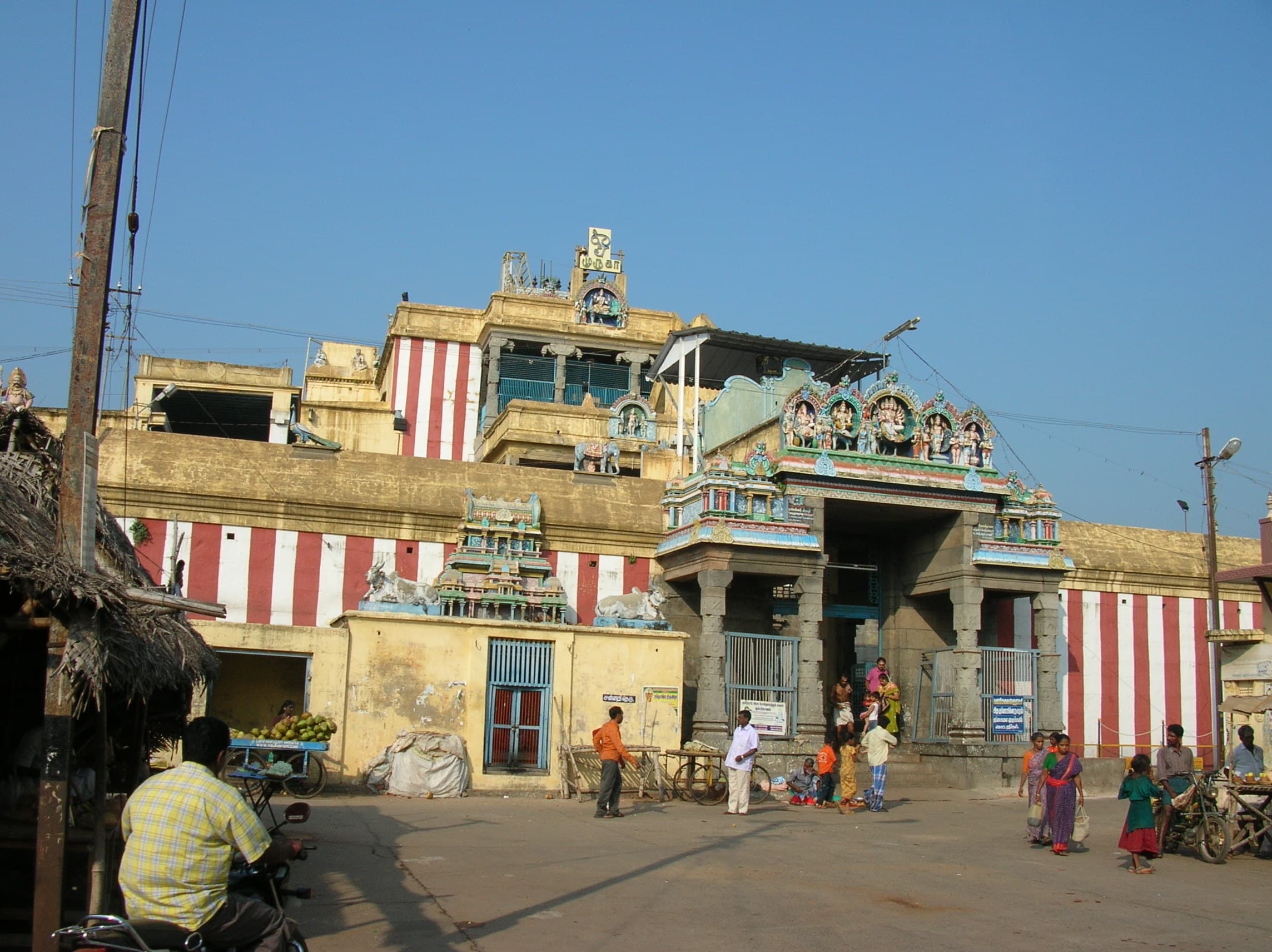
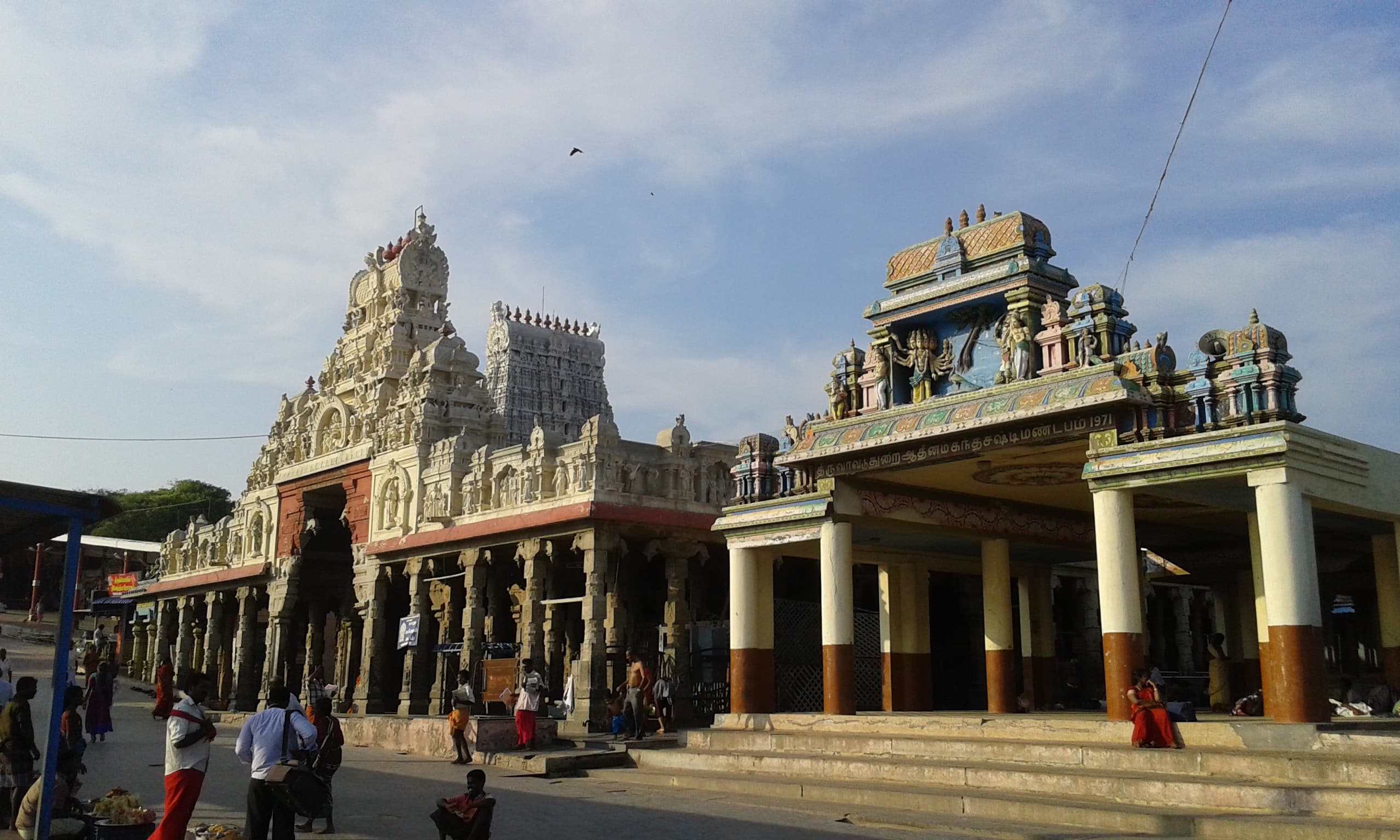
The second Arupadaiveedu — a seaside Murugan temple where the deity defeated the demon Soorapadman. The temple stands directly on the Bay of Bengal shore, making it one of the most dramatic temple settings in South India.
The Rahu (ascending lunar node) Navagraha temple near Kumbakonam, where the presiding deity is Naganatha Swamy (Shiva). Uniquely, Rahu is said to turn white during his worship here — an observed natural phenomenon. The main lingam glows with a mysterious blue light on Rahu worship days. One of the most powerful Navagraha temples.
Saturn (Shani) Navagraha temple. The Shani (Saturn) Navagraha temple at Thirunallaru — one of the most visited in the circuit, as Shani (Saturn) is widely propitiated to ward off hardship.
The first of the six Arupadaiveedu (abodes of Lord Murugan), carved into a rock hill 8 km from Madurai. Murugan is said to have married Devasena (Devayanai) here after the war with Soorapadman. The cave temple dates from the Pandya period.
The first of the six Arupadaiveedu, sacred abodes of Lord Murugan, carved into a rock hill 8 km from Madurai and dating back over a thousand years. It commemorates Murugan's marriage to Deivayanai after his victory over the demon Surapadman, and is among the oldest rock-cut cave temples in Tamil Nadu.
Mercury (Budha) Navagraha temple. The Budha (Mercury) Navagraha temple at Thiruvenkadu, said to be the spot where Mercury worshipped Shiva to be released from a curse.
One of the largest and oldest Shiva temples in Tamil Nadu, covering 25 acres. Lord Thyagaraja (Shiva as the Lord of Dance) is worshipped here with a magnificent Theppam (float festival) on the famous temple tank. The car festival (ther) here uses the world's largest temple chariot.
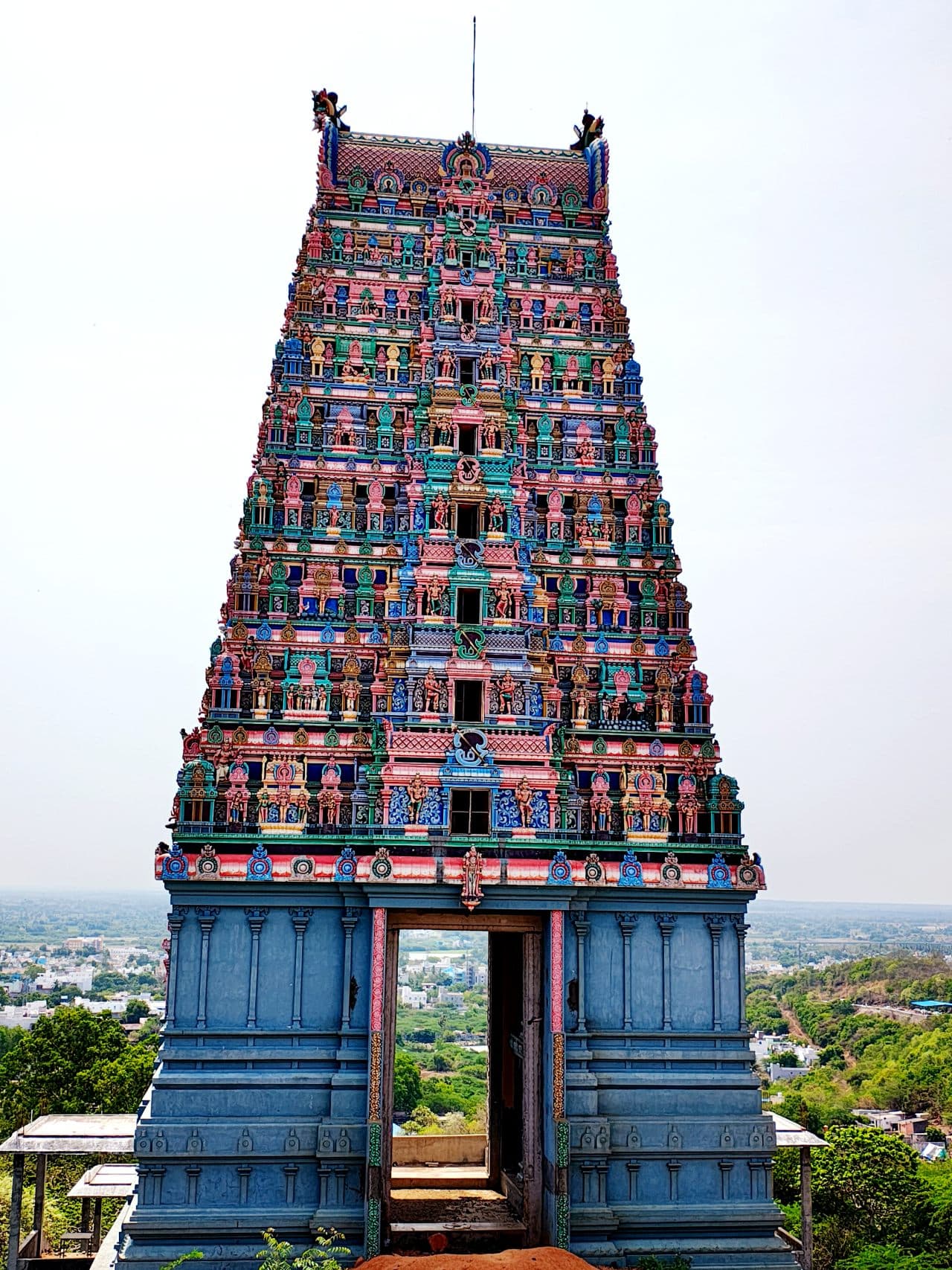
The fifth of the six sacred Arupadaiveedu (abodes) of Lord Murugan, atop a small hill 84 km from Chennai. Murugan is said to have married Valli here after defeating the demon Soorapadman.
Ganesha
A Ganesha temple atop the 83-metre rock fort in the heart of Trichy city. The 437-step climb rewards with panoramic views of Srirangam island, the Kaveri, and the Kollidam rivers. The Rock Fort has both a Shiva cave temple (7th century Pallava) and this Ganesha shrine at the summit.
Vishnu
One of the 108 Divya Desams where Lord Vishnu is worshipped as Trivikrama (who measured the three worlds in three strides as the Vamana avatar). The 'Ulagalanda' (one who measured the worlds) form is unique — the deity's cosmic foot is shown reaching the heavens. On the banks of the South Pennar river, 130 km from Chennai.
One of the most visited Murugan temples in Chennai, built in the 19th century. Lord Murugan (Andavar) is especially revered by the Tamil film industry — actors, directors, and crew visit here before major releases. Receives 50,000+ pilgrims on Skanda Sashti and Kanda Shashti days.
One of the 108 Divya Desams, located on the banks of the Tamirabharani river near Tuticorin. The presiding deity Vaikuntanatha (Vishnu) is in a unique standing posture (a rare form called Thayar Sannidhi). The Shanmukha Nadhi is a sacred water channel here.
Mars (Angaraka) Navagraha temple. The Angaraka (Mars) Navagraha temple, famous for its miraculous sacred tank (Siddhaamirtham) and the deity's power to cure diseases — thousands visit for healing.
One of the 108 Divya Desams, the most important Vishnu temple in Kanchipuram. The 100-pillared hall inside is a masterpiece of Vijayanagara art. The 'Atti Varadar' idol (made of fig wood) is kept submerged in a sacred tank and brought out once every 40 years — the last emergence was in 2019, drawing 15 million visitors.
An ancient Shiva temple near the historic Vedaranyam salt marsh — Gandhi led the Vedaranyam March here in 1930 as a symbolic parallel to the Dandi Salt March. Lord Vedaranyeswarar and Goddess Yogambikai preside. The Mayana Kollai festival (bone-gathering festival) here is unique.